
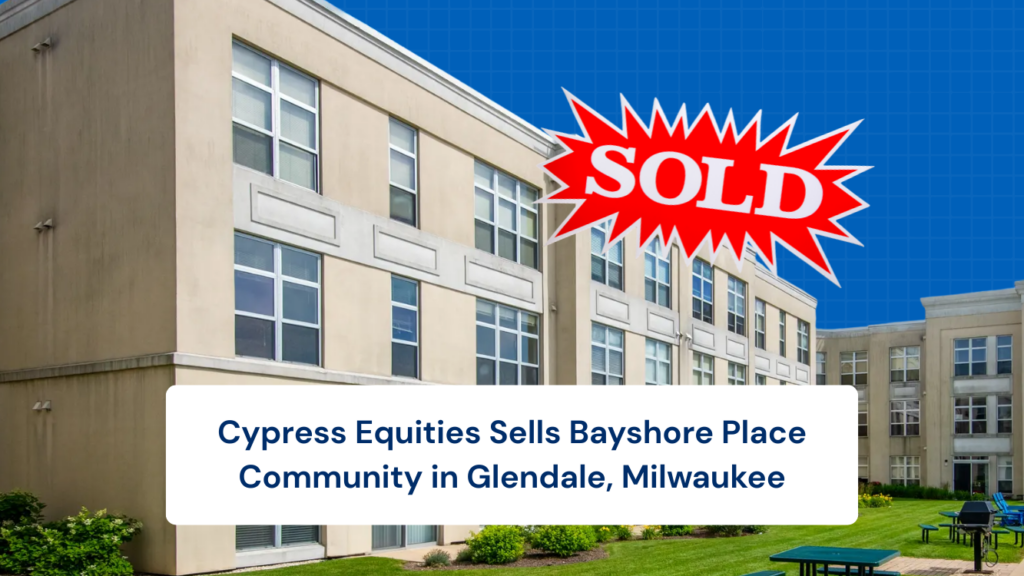
Bayshore Place Apartments in Glendale, Wisconsin highlights tightening margins and a move toward operational value in Milwaukee’s suburban market
The Glendale Milwaukee apartment sale of Bayshore Place Apartments marks a clear shift in how investors approach suburban multifamily assets just north of Milwaukee. Located in Glendale, Wisconsin, the transaction reflects a move away from rent-driven returns toward operational execution and long-term positioning.
Bayshore District Asset Anchors the Deal
Bayshore Place Apartments sits within the Bayshore mixed-use district in Glendale, Wisconsin, a high-traffic suburban node directly tied to Milwaukee’s north-side economic activity. The property was sold by Cypress Equities, signaling an exit after stabilization and positioning the asset for its next operational phase.
The location matters. Glendale functions as a suburban extension of Milwaukee, drawing renters who want proximity to the city without downtown pricing pressure.
Investors Shift from Rent Growth to Execution
The Glendale Milwaukee apartment sale reflects a broader Midwest trend: investors are no longer underwriting deals on aggressive rent increases. Instead, they are targeting operational improvements, cost control and tenant retention as primary return drivers.
Cypress Equities’ exit suggests the asset reached a stabilized phase, while the buyer likely sees value in incremental upgrades rather than pricing expansion.
Rent Growth Pressure Is Reshaping Underwriting
Milwaukee-area rent growth has slowed compared to post-pandemic peaks, forcing investors to adopt more conservative projections. This reduces pricing flexibility and increases the importance of operational performance at the property level.
For Glendale assets, this means competing on quality, amenities and retention, not just price increases.
Source: Federal Reserve housing and rent trend data (https://www.federalreserve.gov/econres.htm)
Cost Pressures Are Now the Primary Constraint
Higher interest rates, rising insurance costs and increased maintenance expenses are compressing margins across multifamily assets. In Glendale and greater Milwaukee, this forces buyers to structure deals more conservatively and plan for active asset management.
The result is a shift from passive ownership to hands-on operation, especially in suburban properties where tenant expectations are rising.
What This Changes for Buyers, Investors and Operators
This Glendale Milwaukee apartment sale resets expectations. Investors must prioritize durability over speed, focusing on steady occupancy and controlled expenses.
Operators need to deploy strategies such as targeted renovations, flexible lease terms and selective concessions to maintain competitiveness. Buyers entering the market benefit from less competition but face higher execution risk.
Applied Insight: Real-World Impact on Deal Strategy
A typical suburban Milwaukee deal now looks materially different.
Before:
An investor underwrites 7–8% annual rent growth with minimal upgrades and plans a quick refinance.
After:
The same investor assumes 2–3% rent growth, allocates capital for unit upgrades and uses concessions to stabilize occupancy.
For example, instead of raising rent by $150, an operator may offer one month free while upgrading interiors, capturing value over time rather than upfront.
The tradeoff is clear: lower short-term returns but more stable long-term performance. Execution becomes the deciding factor, not market momentum.
What Comes Next for Glendale and Milwaukee Multifamily
The Bayshore Place Apartments transaction positions Glendale as a key suburban submarket within the Milwaukee metro where investors can still find value, if they operate effectively.
Future transactions will likely focus on:
- Value-add suburban assets
- Mixed-use proximity like Bayshore
- Conservative financing structures
- Longer hold strategies
This is not a slowdown. It is a reset. The Glendale Milwaukee apartment sale shows a market where precision, not speculation, defines success.