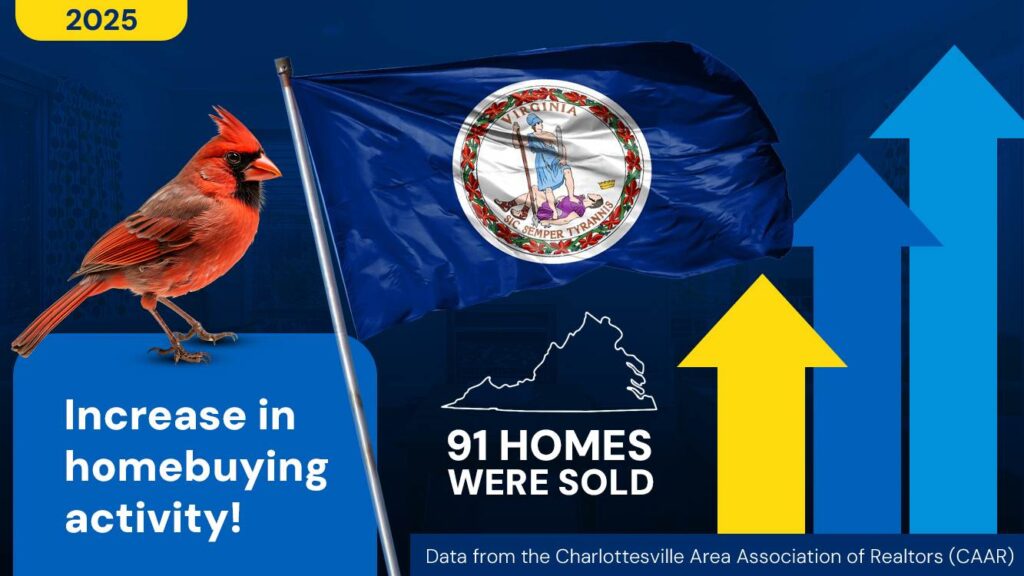
The last quarter of 2025 saw an increase in homebuying activity in Central Virginia. This is the opposite of the typical seasonal slowdown, signaling renewed momentum in the region’s housing market. Data from the Charlottesville Area Association of Realtors (CAAR) show that fourth-quarter sales rose sharply compared with the same period a year earlier, driven in part by declining mortgage rates and slightly improved inventory conditions.
The CAAR 2025 fourth-quarter housing report indicates that home sales increased by about 10% year over year, a notable gain during what is traditionally one of the quietest periods for residential real estate. The report attributes the improvement to easing borrowing costs and a modest shift toward more balanced market conditions, giving buyers additional options.
A total of 91 more homes were sold across the region in the fourth quarter of 2025 compared with the same period in 2024. The growth was not uniform across all localities, but several counties posted particularly strong gains. Fluvanna County recorded a 20% increase in sales activity, while Greene County experienced an 85% surge, highlighting how local dynamics can produce sharply different outcomes within the same regional market.
Lower Mortgage Rates Drive Activity
One of the primary factors behind the stronger fourth-quarter performance was the gradual decline in mortgage rates. By the second week of January 2026, the average rate for a 30-year fixed mortgage had dropped to about 6.06%, nearly a full percentage point below the levels seen at points during 2024.
The reduction in borrowing costs improved affordability for many prospective buyers, especially those who had delayed purchases while rates hovered closer to the 7% to 8% range. As rates moved closer to 6%, more households re-entered the market, contributing to the late-year surge in sales.
The improvement in financing conditions also coincided with a modest increase in the number of homes available for purchase. While inventory remains relatively tight compared with pre-pandemic norms, the number of days homes spend on the market has edged higher. That shift has given buyers slightly more time to evaluate options and negotiate, reducing some of the intense competition that defined earlier phases of the post-pandemic housing cycle.
Market Conditions Continue to Evolve
Real estate professionals in the region note that the market is gradually settling into a more stable pattern after several years of volatility. The extreme swings in demand and supply that began in 2020 disrupted long-standing seasonal trends, making it harder to predict market behavior based on historical data.
Before the pandemic, the fourth quarter was typically characterized by slower sales activity due to colder weather and the holiday season. While those seasonal factors still play a role, recent years have shown that broader economic forces, such as interest rate shifts and inventory levels, now exert a greater influence on buyer behavior.
In Central Virginia, the late-2025 improvement suggests the market is adjusting to a new equilibrium. Higher borrowing costs earlier in the year had suppressed activity, but the subsequent rate declines appear to have unlocked pent-up demand.
Regional Differences Highlight Local Factors
The strong gains in counties such as Greene and Fluvanna underscore how local conditions can shape housing outcomes. Smaller markets with limited inventory can experience sharper percentage swings when even modest increases in buyer activity occur.
Population growth, new construction, and employment trends all influence local demand. Areas that attract new residents or offer relatively affordable housing compared with neighboring counties often see faster sales growth when financing conditions improve.
In contrast, more established or higher-priced markets may experience steadier, less dramatic changes. These variations highlight the importance of analyzing housing data at the county or city level, rather than relying solely on regional averages.
Outlook for Early 2026
The stronger fourth-quarter performance has contributed to cautious optimism about the region’s housing market heading into 2026. Lower mortgage rates have improved affordability compared with the previous year, and the modest increase in inventory has given buyers more options.
However, several factors could shape the pace of activity in the coming months. Winter weather has the potential to delay the start of the traditionally busy spring homebuying season. If harsh conditions persist, some listings and transactions could be pushed later into the spring.
Under more typical conditions, the market tends to gain momentum in late February or early March. Given recent weather patterns and lingering uncertainty around interest rates, the spring surge in activity may not fully materialize until March or April.
Mortgage rates remain a key variable. While they have declined from their recent highs, the future path of rates will depend on broader economic conditions, inflation trends, and Federal Reserve policy. If rates remain near current levels or continue to edge downward, buyer demand could strengthen further. Conversely, any significant increase could dampen activity.
A Market Moving Toward Balance
Overall, Central Virginia’s housing market appears to be transitioning from the extreme conditions of the pandemic years toward a more balanced environment. The fourth-quarter increase in sales, combined with slightly longer marketing times and improved inventory, suggests a market that is stabilizing rather than weakening.
For buyers, the shift may mean more choices and less intense competition than in recent years. For sellers, strong demand and improving sales activity indicate that the market still offers favorable conditions, particularly in high-demand areas.
In 2026, the region’s housing performance will likely hinge on interest rate trends, inventory levels, and the timing of the spring market. The late-2025 sales rebound provides an early sign that the Central Virginia market remains resilient, even as it adapts to changing economic conditions.