
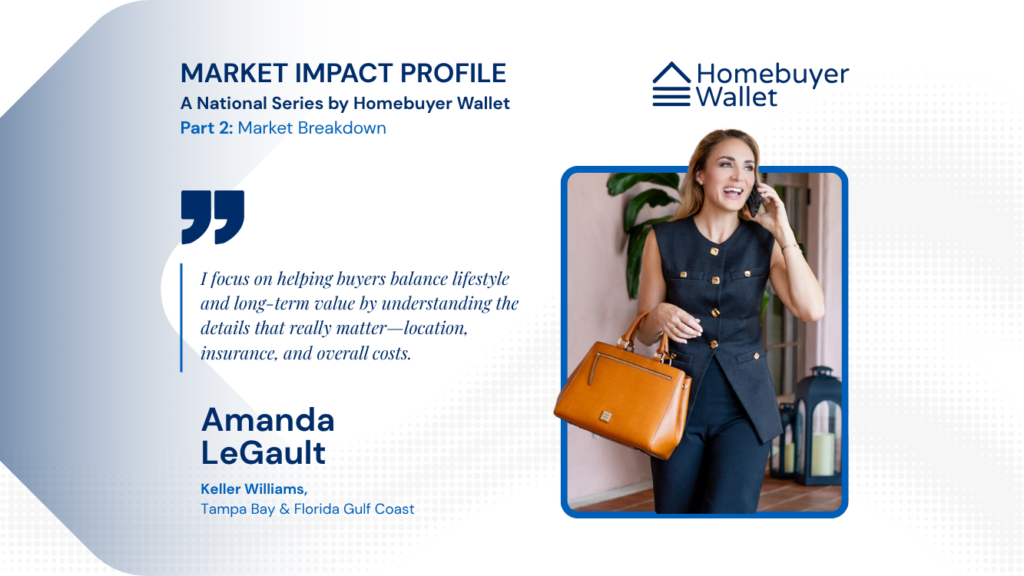
Market Impact Profile: Amanda LeGault helps buyers across Tampa Bay and Florida’s Gulf Coast reduce upfront costs by combining low-down-payment financing, assistance programs, seller concessions, and smarter property selection.
In Tampa Bay and along Florida’s Gulf Coast, Amanda LeGault works in a market where the biggest obstacle is often not the sticker price of the home, but the amount of cash a buyer believes they need to bring to the table. On a typical purchase in the roughly $450,000 to $650,000 range, where many primary-residence buyers still come in with 3% to 5% down and closing costs often land around 2% to 4% of the purchase price, that assumption can keep qualified people out of the market when a more strategic structure would get them to the closing table sooner.
That is where LeGault creates real value. Instead of treating financing as a preapproval and a price cap, she builds the deal from the cash side first, using loan selection, assistance, negotiation and location discipline to reduce the true cost of entry without losing sight of what the buyer is trying to accomplish in Tampa, St. Petersburg, Bradenton, Sarasota, Clearwater, Venice, Osprey and the surrounding Gulf Coast market.
Financing access is the process of reducing the real cash needed to buy, not just finding a loan.
The Cash Barrier Is Usually Bigger Than Buyers Realize
In this part of Florida, buyers are not just choosing between neighborhoods or home styles. They are also navigating flood exposure, insurance variability, HOA obligations, tax resets, and, in some cases, rental restrictions that can change the financial picture from one block to the next. That makes cash close to a moving target, and buyers who look only at list price often miss what the property will really require upfront and month to month.
LeGault understands that the market’s appeal can blur the harder math. Buyers come for sunshine, walkable downtowns, water access and the sense that they can still get more for their money than in Miami, California or the Northeast, but that relative value disappears quickly if they underestimate insurance, taxes or the amount due at closing. Her work is not simply helping a buyer want the market. It is structuring a purchase so the market remains workable after the excitement wears off.
That is why the strongest opening move is often to reframe what affordability means. A buyer shopping in the $300,000 to $450,000 range for a condo or smaller single-family home faces a different set of constraints than a move-up buyer in the $450,000 to $700,000 range, but both can get stuck if they assume they need a large conventional down payment and must absorb every closing cost themselves. LeGault’s strategy works because it challenges that assumption early.
Low-Down-Payment Financing Resets the Starting Line
The first lever is loan structure. LeGault points to First-Time Homebuyer Programs that can offer lower down payment options as low as 3%, FHA Loans that typically require 3.5% down with more flexible qualification, and Conventional Loans with low down payment options that can go as low as 3% to 5% for qualified buyers and may carry a better long-term cost structure than FHA.
That matters because it changes the buyer’s starting point before negotiations even begin. A buyer who believes the path to ownership requires a large upfront cash commitment may delay for years, while a buyer who understands that a primary residence may be possible with 3%, 3.5% or 5% down can start evaluating real options now, inside the actual financing lanes available to them. In a market where typical closings move in about 30 to 45 days, that clarity can turn hesitation into action fast.
One of the most revealing lines in LeGault’s approach is also one of the simplest: “Great for buyers who have solid income but want to keep cash on hand.” That is not the language of someone pushing programs for the sake of programs. It is the language of someone who understands that preserving liquidity can be part of a smart purchase, especially in a Florida market where insurance, maintenance and storm-related costs can surprise buyers who arrive undercapitalized.
Stacking Assistance and Credits Produces the Breakthrough
The centerpiece of LeGault’s strategy is not a single product. It is the way she combines tools that many buyers think of separately. She uses Down Payment Assistance programs to help cover down payment and or closing costs, then adds a second layer through seller concessions and, in some cases, a third through new construction incentives such as rate buydowns, closing cost credits or upgrades.
That is where the out-of-pocket shift happens. A buyer may enter the process focused only on how much they can save for a down payment, but LeGault’s logic starts with a different question: Which parts of this cash requirement can be reduced, transferred or offset through the right combination of financing, assistance and negotiation? Once that question changes, the deal changes.
The strongest quote in her approach sharpens that point: “Not a loan program, but something I use strategically negotiating for the seller to cover part of the buyer’s closing costs.” That line reveals both temperament and method. It shows an agent who does not stop at loan approval and who understands that affordability often improves not through theory but through line items moved off the buyer’s side of the settlement statement.
In a softer market, this becomes even more powerful. If homes are sitting longer, prices are stabilizing or softening in some areas and inventory is giving buyers more options, then assistance and concessions are no longer side conversations. They become part of how LeGault engineers a workable purchase for buyers who might otherwise assume the market is out of reach.
Negotiation Has Returned to the Gulf Coast Market
Timing matters here, and LeGault is working in a market that is giving buyers more room to structure deals than it did during the most aggressive appreciation period. Inventory has been rising across Tampa Bay and Florida, homes are sitting longer, and seller concessions, price reductions and full inspection periods are becoming common again. That combination does not merely improve buyer morale. It creates negotiating room that she can turn into dollars saved.
That is especially important in a region where lifestyle premiums can tempt buyers to stretch. Walkability, beach access, boating, downtown proximity and water access all carry weight here, and micro-location matters more than many out-of-state buyers expect. Being a few blocks closer to the water or in a different flood zone can affect insurance, long-term cost and resale in ways that radically change the wisdom of the purchase.
A less strategic agent might treat those details as cautionary footnotes. LeGault folds them directly into the affordability plan. Negotiation is not just about price reduction. It is about protecting the buyer from paying upfront for a property whose carrying costs will make the win feel temporary.
Property Selection Protects the Buyer After Closing
This is where LeGault’s financial logic becomes more sophisticated than a generic low-down-payment story. She is not only looking for a way to get buyers into contract. She is also steering them toward areas just outside major hotspots, neighborhoods with ongoing renovation and new development, non-flood-zone properties that are becoming more valuable over time, and condo segments where prices have adjusted more than single-family homes. Those choices do not just create price opportunity. They can also reduce the hidden cost pressure that blows up affordability after closing.
Florida punishes lazy assumptions. Insurance is not one-size-fits-all, property taxes can reset after purchase, homestead exemption matters, and condo or HOA financial health can affect monthly obligations more than buyers expect. Two homes can look comparable online and produce very different ownership outcomes once flood exposure, reserves, assessments, rental rules and maintenance risk come into view. LeGault’s strategy accounts for that before the buyer learns it the hard way.
The clearest line in her approach may also be the most accurate summary of her role: “This is a market where you can create a lot of value—but only if you understand the details and approach it strategically.” That is not a throwaway observation. It is the governing rule of buying well in Tampa Bay and Florida’s Gulf Coast, and it is the principle that ties together LeGault’s use of programs, concessions, incentives and property selection.
The Result Is a Structured Path to Ownership, Not a Generic Search
The strongest way to understand Amanda LeGault’s work is not as a guide to a hot market or a curator of lifestyle appeal. It is the work of an agent who lowers the real barrier to entry in a region where buyers often overestimate the cash they need and underestimate the details that will shape ownership after closing. That is a more useful kind of expertise because it turns aspiration into structure.
For buyers across Tampa, St. Petersburg, Sarasota, Bradenton and the surrounding Florida Gulf Coast, that distinction matters. The pathway is not magical, and it is not one universal program. It is a sequence: choose the right low-down-payment financing, layer in down payment assistance where it fits, negotiate seller concessions when the market allows, use new construction incentives where they materially improve the deal, and avoid properties whose insurance, tax or HOA profile will erase the initial win. When Amanda LeGault handles that sequence well, buyers do not just get a house. They get into the market with a structure that holds.
Want to connect with Amanda? You can follow her on Tiktok, Instagram, Facebook or LinkedIn.