
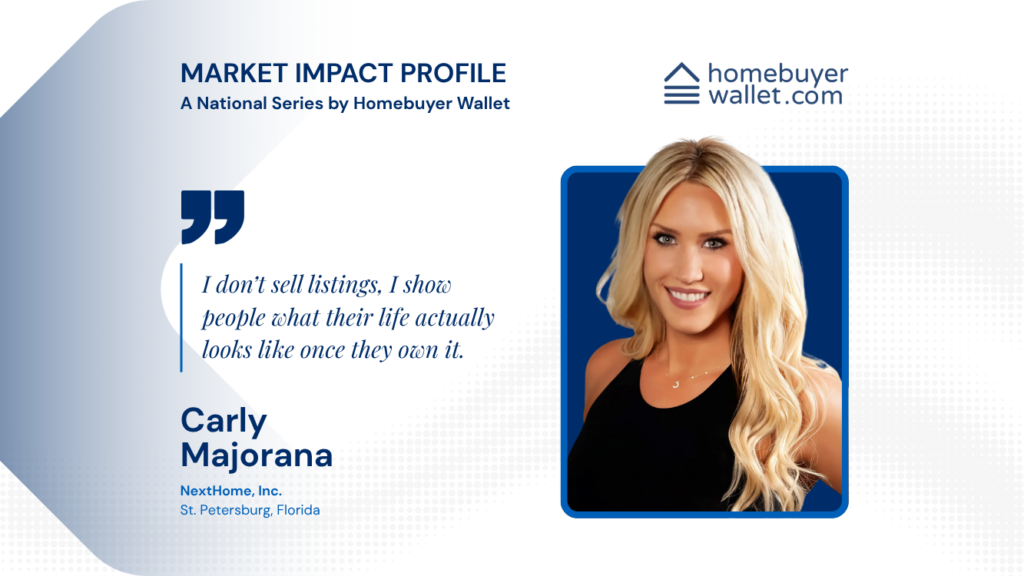
Market Impact Profile: Carly Majorana of NextHome Gulf Coast on navigating waterfront living in St. Petersburg, Florida, and the surrounding Tampa Bay communities.
Carly Majorana does not sell waterfront homes in St. Petersburg, Florida as properties to compare on a spreadsheet. She positions them as lifestyle decisions where missing one detail can quietly undermine the entire purchase. As a Realtor with NextHome Gulf Coast and a Certified Luxury Home Marketing Specialist (CLHMS) with Guild recognition and multiple $2M-plus waterfront sales, Majorana intentionally keeps her transaction volume at a manageable level to ensure clients receive her direct attention throughout the entire process. That structure, combined with lifestyle-driven marketing that generates 2 to 3 million monthly views, consistently brings in buyers who already understand what they are purchasing before they ever schedule a showing.
Lifestyle Alignment Drives Waterfront Buying Decisions
Majorana reframes the starting point of every search. In St. Petersburg and St. Pete Beach, Florida, she shifts buyers away from square footage and toward daily use of the property, because the wrong assumption at the beginning compounds quickly once a contract is in place.
“You’re not just buying a house in St. Pete, you’re buying what your normal Tuesday looks like,” she said. “Most buyers here don’t care about square footage the way they think they do.”
This approach changes how properties are evaluated in real time. A home with less interior space but immediate water access, functional dockage and navigable depth often outperforms larger homes that require planning, trailering, or limited access to the water. Majorana builds the decision around how often the buyer will actually step outside and use the asset, not how it photographs online.
In waterfront real estate, the true asset is the daily lifestyle the property enables, not the structure itself.
Digital Visibility Translates Into Pre-Qualified Waterfront Demand
Majorana’s marketing does not rely on listing distribution alone. Her content shows real waterfront use, including boat days, dock access and unfiltered moments that mirror how buyers will live after closing.
That strategy produces measurable scale. With 2 to 3 million monthly views, her listings reach a specific audience that already understands the difference between owning near the water and owning on it. By the time a buyer reaches out, the conversation has already moved past basics and into execution.
“They’re not just looking for a house in St. Petersburg or St. Pete Beach,” she said. “They’re ready for the lifestyle that comes with it.”
This compresses the front end of the transaction. Buyers arrive with clarity, which allows Majorana to focus immediately on feasibility, property fit and risk exposure instead of education.
Waterfront Complexity Requires Preemptive Risk Management
Waterfront transactions in Tampa Bay introduce variables that do not appear in standard residential deals. Seawalls, dock permits, water depth, flood zones and insurance constraints all carry financial consequences that often surface after a contract is signed if they are not addressed early.
Majorana builds her process around identifying those issues before they become negotiation points. She evaluates dock functionality, verifies water depth for intended boat use and flags restrictions that could limit access long term.
“I’ve seen people find out too late they can only take their boat out at high tide,” she said.
That level of diligence removes uncertainty from the transaction. Instead of reacting to inspection findings or insurance limitations mid-deal, she positions her clients with full visibility before they commit, which reduces fallout and renegotiation risk.
“My clients don’t get surprised halfway through a deal, because I’ve already thought a few steps ahead,” she said.
A Low-Volume Model Preserves High-Stakes Execution
Majorana’s decision to keep her transaction volume at a manageable level is not a capacity issue. It is a deliberate structure designed to maintain control over deals that require continuous oversight.
From the initial call through closing, she remains the sole point of contact. That consistency prevents information gaps that can occur when responsibilities are distributed across a larger team, particularly in transactions where one overlooked detail can alter the outcome.
Her background reinforces that model. Years spent building a business in the beauty industry and working in high-pressure marketing environments shaped a mindset built on direct accountability and fast decision-making. She entered real estate without a fallback plan, and that approach still defines how she operates.
“I don’t wait for deals, and I don’t let clients make decisions they’ll regret,” she said.
Market Conditions Are Creating a Window for Strategic Buyers
The current St. Petersburg, Florida market is producing a divergence between waterfront and non-waterfront inventory. Non-waterfront homes are typically moving within 50 to 80 days, while waterfront properties are taking longer overall to sell.
That extended timeline is creating leverage for buyers who understand the segment. Motivated sellers are more open to negotiation, particularly on properties that lack strong dockage or immediate lifestyle appeal.
At the same time, the top tier of waterfront homes is not experiencing the same slowdown. Properties with functional docks, favorable water depth and true usability continue to move quickly when priced correctly.
This split reinforces Majorana’s approach. Buyers who align lifestyle, property functionality and timing can secure stronger terms, but only if they recognize which properties will hold demand and which will not.
Client Relationships Extend Beyond the Transaction
Majorana’s work does not end at closing. Many of her clients remain connected through the lifestyle they purchased, whether that means time on the water or shared trips beyond Tampa Bay.
That continuity reflects the nature of her client base. Many are second-home buyers, relocations or individuals upgrading into waterfront living, which creates an ongoing relationship tied to how they use the property rather than a single transaction.
“I don’t run my business like a traditional agent, and I don’t attract traditional clients,” she said.
The result is a model built on trust and long-term alignment. Clients rely on her not just to complete a purchase, but to ensure the property supports how they intend to live well after the deal is done.
Want to connect with Carly? You can follow her on Instagram, Facebook, TikTok, or LinkedIn, visit her personal website for more details, or send her an email directly.