
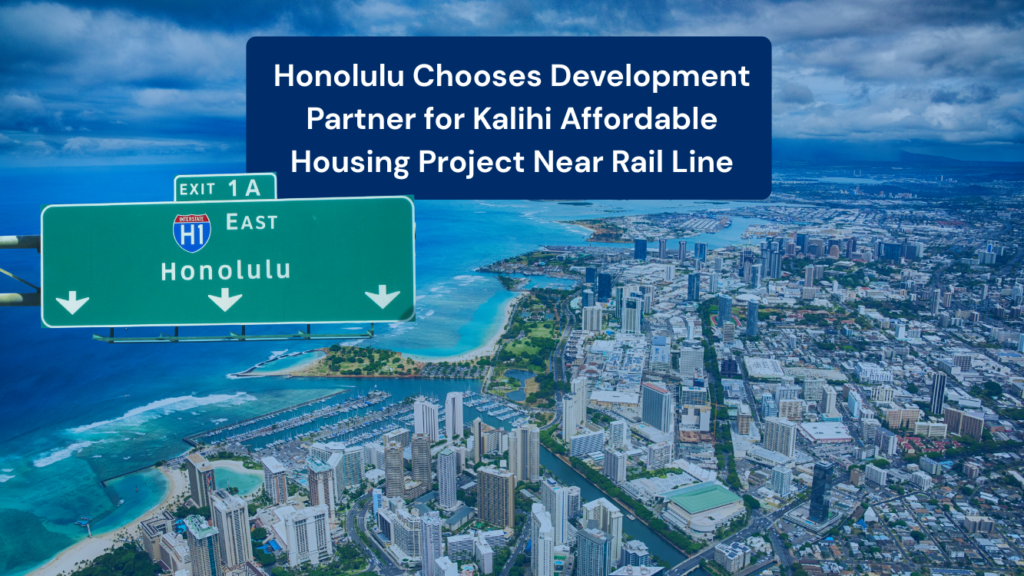
Honolulu has moved forward on its Honolulu affordable housing rail corridor strategy by selecting EAH Housing to develop a transit-linked project in Kalihi, a step aimed at expanding below-market housing while lowering land-related costs. The project could deliver more than 150 affordable rental units on publicly owned land near a future rail station, directly tying housing supply to transit access.
Transit-Oriented Land Use Drives Housing Supply
The city’s plan centers on redeveloping the former Dee Lite Bakery site along Dillingham Boulevard, a parcel acquired in 2019 to support long-term affordable housing goals. Located near a future Honolulu Skyline station, the site sits within a designated transit-oriented development (TOD) zone intended for higher-density residential use.
Honolulu’s TOD framework prioritizes building housing near transit infrastructure to reduce car dependency and concentrate growth within existing urban areas. This approach aligns with broader urban planning models that link transportation access to housing affordability and sustainability outcomes.
Public Land Strategy Reduces Development Costs
The city will retain ownership of the Kalihi site and lease it to the developer through a long-term ground lease, eliminating land acquisition costs, one of the largest barriers to housing development in Hawaii. This structure allows more capital to flow into construction and affordability requirements rather than land purchase.
This model reflects a broader shift toward public-private partnerships, where governments use land control as leverage to enforce long-term affordability. By maintaining ownership, Honolulu ensures that units remain income-restricted for decades rather than converting to market-rate housing.
Kalihi Emerges as a Priority Housing Zone
Kalihi’s location, less than two miles from downtown Honolulu, makes it a strategic target for affordable housing expansion. The neighborhood already offers access to schools, jobs, and commercial services, reducing the need for long commutes.
Rising housing costs across Oahu have intensified pressure on working families, with limited land supply and high construction costs driving both rents and home prices upward. Increasing density in transit-accessible areas like Kalihi allows the city to add units without expanding into undeveloped land.
Development Pipeline Expands Through Partnerships
The Kalihi project is part of a broader pipeline that includes multiple publicly owned sites across Honolulu. The city has issued ten redevelopment solicitations and is negotiating projects in areas such as Iwilei, Ala Wai, and Kapolei.
Several projects are already under development, including Kihapai Place and Kaleimaʻo Village, reflecting a coordinated push to scale affordable housing production through partnerships with nonprofit and private developers.
What Changes for Developers, Renters, and Investors
The shift to transit-oriented, publicly controlled land changes the economics of housing development in Honolulu.
Concrete scenario:
A developer building 150 units on private land might spend 30–40% of total project costs on land acquisition. Under a ground lease model, that cost drops near zero upfront, allowing the developer to allocate funds toward construction, deeper affordability levels, or financing incentives like low-income housing tax credits (LIHTC).
Before vs. after:
- Before: High land costs → fewer units, higher rents
- After: Public land lease → more units, lower rent thresholds
Mechanism in practice:
Developers can layer financing tools such as LIHTC equity, tax-exempt bonds, and local subsidies while avoiding land debt, improving project feasibility and speeding approvals.
Constraint:
The tradeoff is reduced flexibility. Developers must comply with strict affordability requirements and long-term lease terms, limiting potential upside compared to market-rate projects.
Regulatory Process Will Shape Final Outcome
The Kalihi project remains in early stages and must pass environmental reviews, community consultations, and City Council approval before construction begins. These steps will determine final unit counts, income eligibility thresholds, and project design.
While these requirements can extend timelines, they also ensure alignment with community needs and environmental standards, a critical factor in dense urban redevelopment.
Long-Term Outlook for Transit-Linked Housing
Honolulu’s approach signals a durable shift toward linking housing production with transit infrastructure. By controlling land and partnering with experienced developers, the city increases its leverage over affordability outcomes while scaling supply in high-demand areas.
If executed at scale, this model could stabilize rental costs for lower- and moderate-income households while reducing congestion and infrastructure strain. The Kalihi project, though modest in size, represents a replicable template for future developments along the rail corridor.