
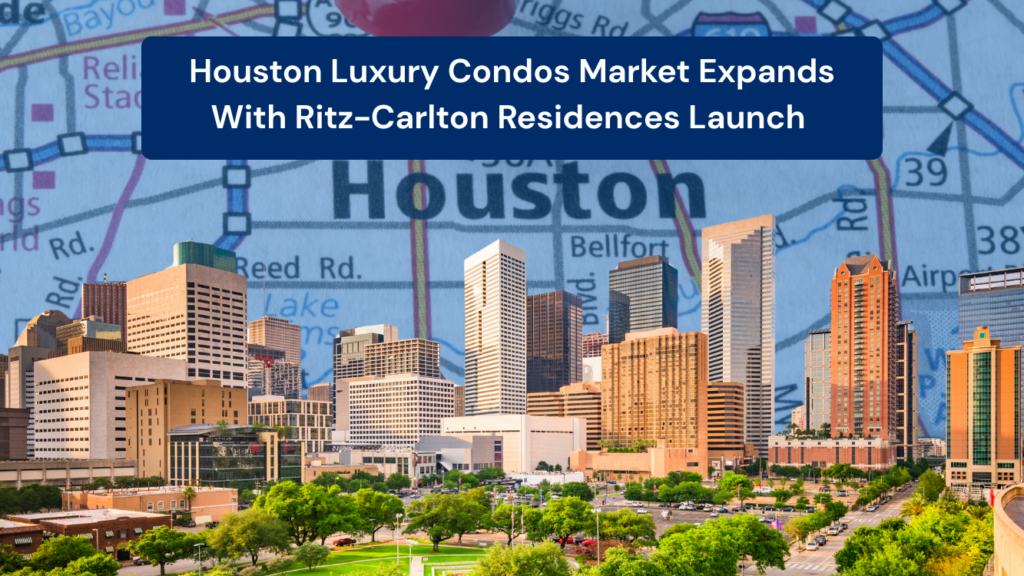
The Houston luxury condos market is entering a new phase as The Ritz-Carlton Residences, Houston begins sales, introducing a $3 million–$30 million price band that materially expands access to ultra-luxury inventory in the city. The project adds a globally branded product to a market historically defined by local high-rise developments, shifting both pricing expectations and buyer profiles.
A Flagship Development Redefines the Upper Tier
The Ritz-Carlton Residences, Houston will rise as a 45-story mixed-use tower in the Uptown-Galleria district, combining a 156-room hotel with 112 private residences. This structure introduces a hybrid ownership model where buyers gain full title to units while accessing hotel-level services.
This model reflects a broader shift toward branded residential living, where real estate functions as both housing and a service-driven asset. According to Knight Frank, branded residences command price premiums of up to 30% globally due to brand association and service integration.
Pricing Expansion Signals New Buyer Access
Units in the development range from approximately $3 million to over $30 million, positioning the tower at the top of Houston’s pricing spectrum. This creates a new tier of inventory that did not previously exist at this scale in the Houston luxury condos market.
Source: Ritz-Carlton Residences Houston pricing details (provided source)
Houston has historically offered lower price-per-square-foot compared with coastal luxury markets. Data from the National Association of Realtors shows that median condo prices in major U.S. metros remain significantly lower in Texas, creating an entry point for global capital.
The result is a widening gap between standard luxury and ultra-luxury inventory, giving high-net-worth buyers more options while pushing price ceilings higher.
Limited Supply Creates Scarcity-Driven Leverage
The tower includes just 112 residences, with sizes ranging from roughly 2,300 to nearly 10,000 square feet. This constrained supply contrasts with larger condo towers that often deliver several hundred units.
Scarcity is a key pricing driver. JLL reports that limited inventory in the ultra-luxury segment consistently supports price stability even during broader market slowdowns.
For buyers, this shifts leverage. Instead of negotiating discounts typical in broader condo markets, purchasers in this segment often compete for allocation in early sales phases.
Branded Residences Reshape Buyer Expectations
Branded developments offer services such as concierge, housekeeping, and wellness programming, effectively merging residential ownership with hospitality operations.
This trend is accelerating nationwide. Savills notes that branded residences have grown by more than 150% globally over the past decade, driven by demand for turnkey living and asset diversification.
In Houston, this introduces a new expectation: ownership is no longer just about space and location but also about service and lifestyle infrastructure.
Houston’s Economic Position Attracts Global Capital
Developers are positioning the project as a response to Houston’s expanding role in international business and population growth.
The U.S. Census Bureau reports continued population growth in Houston’s metro area, reinforcing demand for higher-end housing options.
Combined with lower land costs compared to cities like New York or Los Angeles, Houston creates a rare dynamic: global-city demand with relatively lower development barriers.
What Changes Now for Buyers and Investors
The launch of this project changes how buyers approach the Houston luxury condos market.
Concrete scenario:
A buyer previously targeting a $1.5M penthouse in Houston can now consider a $3M entry-level branded unit that includes services, potentially reducing the need for separate lifestyle spending (club memberships, concierge services).
Before vs. after:
Before: Luxury buyers chose between space and service.
After: Buyers can purchase both in a single asset, shifting decision-making toward experience rather than square footage alone.
Constraint:
These units carry higher HOA and service fees, which can materially impact total cost of ownership despite strong long-term appreciation potential.
From a financing perspective, most purchases in this segment remain cash-heavy or rely on jumbo loans, limiting accessibility compared to conventional condo buyers.
What Comes Next for the Houston Luxury Condos Market
The Ritz-Carlton Residences is not an isolated development. Projects like the St. Regis Residences and other high-end towers are entering the pipeline, signaling sustained expansion in branded luxury inventory.
This suggests a structural shift rather than a one-off event. As more branded developments enter the market, pricing stratification will deepen, and Houston will increasingly compete with global cities for ultra-high-net-worth buyers.
For operators and investors, this creates a new benchmark: success is no longer defined by occupancy or resale value alone but by the ability to deliver integrated residential and hospitality experiences.