
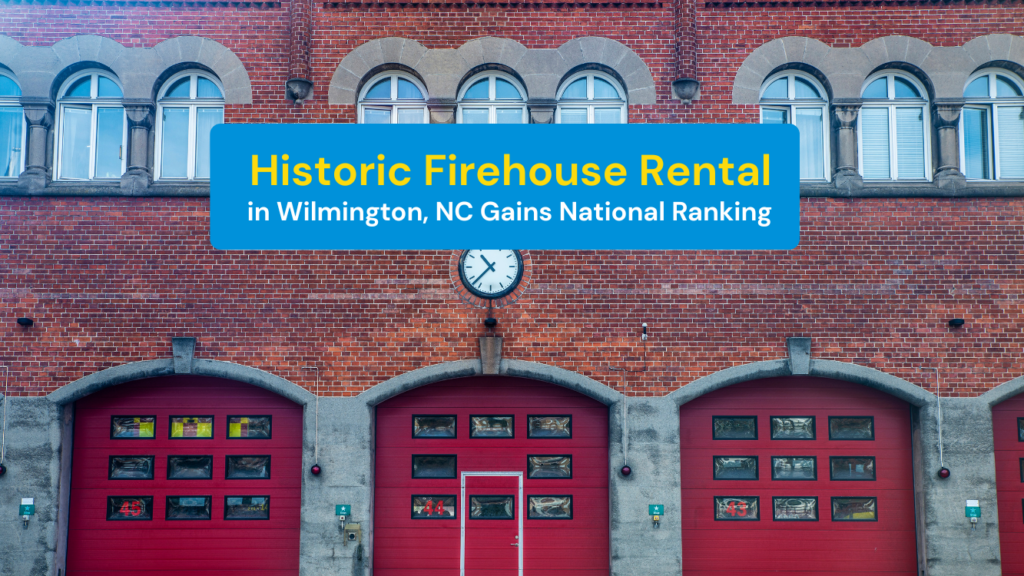
A historic firehouse rental Wilmington NC has been recognized among the best rentals in the United States, reinforcing a clear shift in short-term rental demand toward distinctive, experience-driven properties. The listing, located in Wilmington, North Carolina, stands out not for size or price alone, but for its adaptive reuse design and scarcity-driven appeal.
Unique Property Recognition Signals Pricing Power Shift
The Wilmington firehouse’s inclusion among top U.S. rentals reflects a broader trend: travelers increasingly prioritize character and experience over standardized accommodations. Converted buildings—firehouses, churches, industrial lofts—command premium nightly rates due to limited supply and strong visual identity.
This trend aligns with broader short-term rental data showing that unique listings consistently outperform traditional units on occupancy and nightly rate. Properties labeled as “unique stays” on platforms like Airbnb often see higher engagement and booking velocity compared to standard apartments.
Adaptive Reuse Drives Scarcity and Demand
The firehouse’s appeal comes from adaptive reuse—a strategy that converts obsolete buildings into residential or hospitality assets. This approach creates inherent scarcity, which directly impacts pricing leverage.
Across U.S. markets, adaptive reuse projects have accelerated as developers seek alternatives to ground-up construction amid rising costs and zoning constraints. These properties often bypass some entitlement barriers while delivering differentiated product.
In Wilmington, a coastal city with tourism demand and limited historic inventory, that scarcity becomes even more pronounced. The result: a property that competes not on square footage, but on uniqueness and story.
Travelers Shift Toward Experience-Based Stays
Consumer behavior now favors experiential lodging. Travelers increasingly choose properties that offer narrative value, places they can photograph, share, and remember, rather than purely functional accommodations.
This shift has reshaped demand patterns across the short-term rental sector. Listings with architectural uniqueness, historic relevance, or design differentiation command higher occupancy even during off-peak periods.
For operators, that translates into measurable leverage: higher nightly rates, stronger booking consistency, and reduced reliance on discounting.
What Changes Now for Investors and Operators
This recognition does not just elevate one property, it signals a broader investment thesis shift. Standard short-term rental inventory faces increasing competition and margin compression, while differentiated assets gain pricing power.
Investors now face a clearer fork:
- Compete on price with commoditized inventory
- Or compete on experience with scarce, unique properties
The Wilmington firehouse exemplifies the second path. Its recognition validates that differentiation, not scale, is driving returns in many markets.
Applied Insight: How This Plays Out in Real Deals
A buyer evaluating a $600,000 property in Wilmington faces two options.
Scenario:
- Option A: Standard 2-bedroom rental averaging $180/night at 65% occupancy
- Option B: Unique converted property averaging $325/night at 70% occupancy
The second option generates significantly higher gross revenue despite similar acquisition cost. That gap reflects experience-driven demand, not location alone.
Before vs. After Shift:
- Before: Investors prioritized unit count and location proximity
- After: Investors prioritize uniqueness, story, and visual differentiation
Financing Mechanism in Play:
To acquire or reposition a unique property, buyers often rely on:
- Renovation loans (e.g., Fannie Mae HomeStyle Renovation Loan)
- Seller credits to offset conversion costs
- Rate buydowns to stabilize early cash flow
These tools reduce upfront capital pressure while enabling repositioning into higher-yield assets.
Constraint and Tradeoff:
Unique properties carry higher execution risk. Renovation complexity, zoning limitations, and maintenance costs can erode margins if mismanaged. Liquidity may also be lower compared to standardized assets.
What Comes Next for the Market
The Wilmington firehouse recognition points to a broader evolution: short-term rental markets are fragmenting into commodity inventory and premium experiential assets.
As supply grows in standard rentals, pricing pressure will increase in that segment. Meanwhile, unique properties, especially those rooted in historic or adaptive reuse, will retain leverage due to limited replication.
Cities like Wilmington, with historic architecture and tourism demand, are positioned to benefit from this shift. Operators who secure and reposition distinctive properties early will likely capture outsized returns relative to traditional rental strategies.